Gate Automation for Equestrian and Rural Properties in Palm Beach County.
From Wellington’s equestrian communities to rural properties in Loxahatchee, The Acreage, and Jupiter Farms, selecting the right automated gate design is essential for dependable access, security, and an entrance that complements the property.
Palm Beach County includes a wide range of unique properties, from Wellington’s equestrian communities to rural estates in Loxahatchee, The Acreage, and Jupiter Farms. These properties often need more than a standard driveway gate.
An automated gate should provide security, convenience, and an entrance that matches the character of the property. However, selecting the right gate is not only about appearance. The design must also work with the driveway, available space, property access needs, and the types of vehicles entering the property.
Equestrian and rural properties may regularly receive horse trailers, farm equipment, delivery vehicles, veterinarians, contractors, and guests. The entrance should be planned so these vehicles can enter and exit comfortably without creating unnecessary access problems.
The choice between a swing gate and a sliding gate will depend on the property layout. Gate size, weight, construction, power availability, and access-control preferences also influence the final design.
Choosing equipment before evaluating the property can lead to performance issues, unnecessary repairs, or a gate that does not function well for the owner’s daily needs. A professional site assessment helps determine the most appropriate direction before major decisions are made.
Busanti Gate Company works with residential, rural, equestrian, and commercial properties throughout Palm Beach County. We help property owners evaluate their entrance, gate design, automation needs, and access-control options.
Let’s build together.
Visit BusantiGateCompany.com to request a gate assessment.
Tropical Mayhem vs. Your Gate Operator: Summer Pest Damage in Palm Beach County
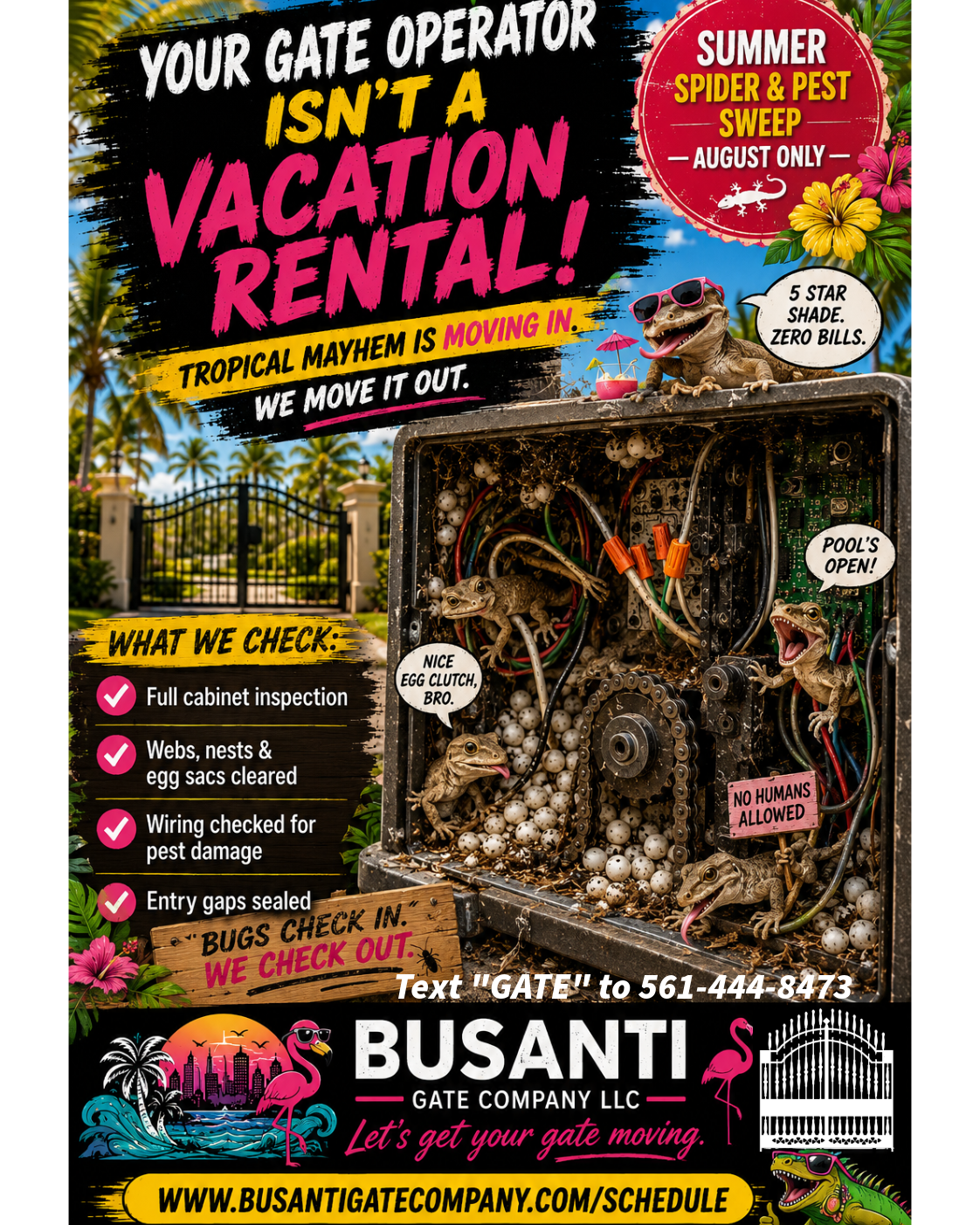
Busanti Gate Company Summer Spider & Pest Sweep flyer showing a gate operator cabinet full of lizards, webs, and egg sacs — August-only pest inspection in Palm Beach County.
It’s almost August in South Florida, which means two things are true: the pool’s open, and every gecko, spider, and six-legged freeloader within a quarter mile has found the one spot on your property with shade, warmth, and zero rent — the inside of your gate operator cabinet.
We open these cabinets all summer long, and we can tell you: it’s a resort in there. Webs strung across the control board like party lights. Egg sacs tucked between the wiring. A lizard sunning himself on the limit switch like he pays the electric bill.
It’s funny right up until it isn’t.
Why Pests Love Your Gate Operator
A gate operator cabinet is warm, dry, dark, and protected from rain and predators. To the tropical mayhem outside your fence line, that’s a five-star listing. Pests move in fast during the summer months — and once they do, they don’t just lounge around.
What “Tropical Mayhem” Actually Costs You
The damage adds up quietly:
• Chewed and corroded wiring. Insects and small reptiles gnaw insulation and leave behind moisture and waste that corrodes connections. That’s how a gate starts “acting up” with no obvious cause.
• Webs and nests jamming moving parts. Debris works its way into chains, gears, and sensors. Intermittent faults, stalled cycles, and safety-sensor errors often trace back to a nest you never knew was there.
• Egg sacs = next season’s problem. One clutch left behind in August is a full infestation by fall.
• Shorted control boards. The most expensive component in your operator is also the coziest spot in the cabinet. A single pest bridging the wrong contacts can take out the whole board.
A seasonal sweep costs a fraction of a control board replacement — and a lot less than a gate stuck closed when you’re trying to leave for work.
The Summer Spider & Pest Sweep — August Only
For the month of August, we’re running a dedicated Summer Spider & Pest Sweep for gate operators across Palm Beach County. Here’s what we check:
• Full cabinet inspection — every corner, top to bottom
• Webs, nests & egg sacs cleared — evicted, no notice required
• Wiring checked for pest damage — before a chewed wire becomes a dead gate
• Entry gaps sealed — so the next wave of squatters finds the “No Vacancy” sign
Bugs check in. We check out.
Book Your Sweep
This one’s August only — once the calendar flips, so does the offer.
Text “GATE” to 561-444-8473 or schedule online at www.busantigatecompany.com/schedule.
Busanti Gate Company LLC — Let’s get your gate moving.
Gate Design and Automation: Why They Should Be Planned Together | Busanti Gate Company
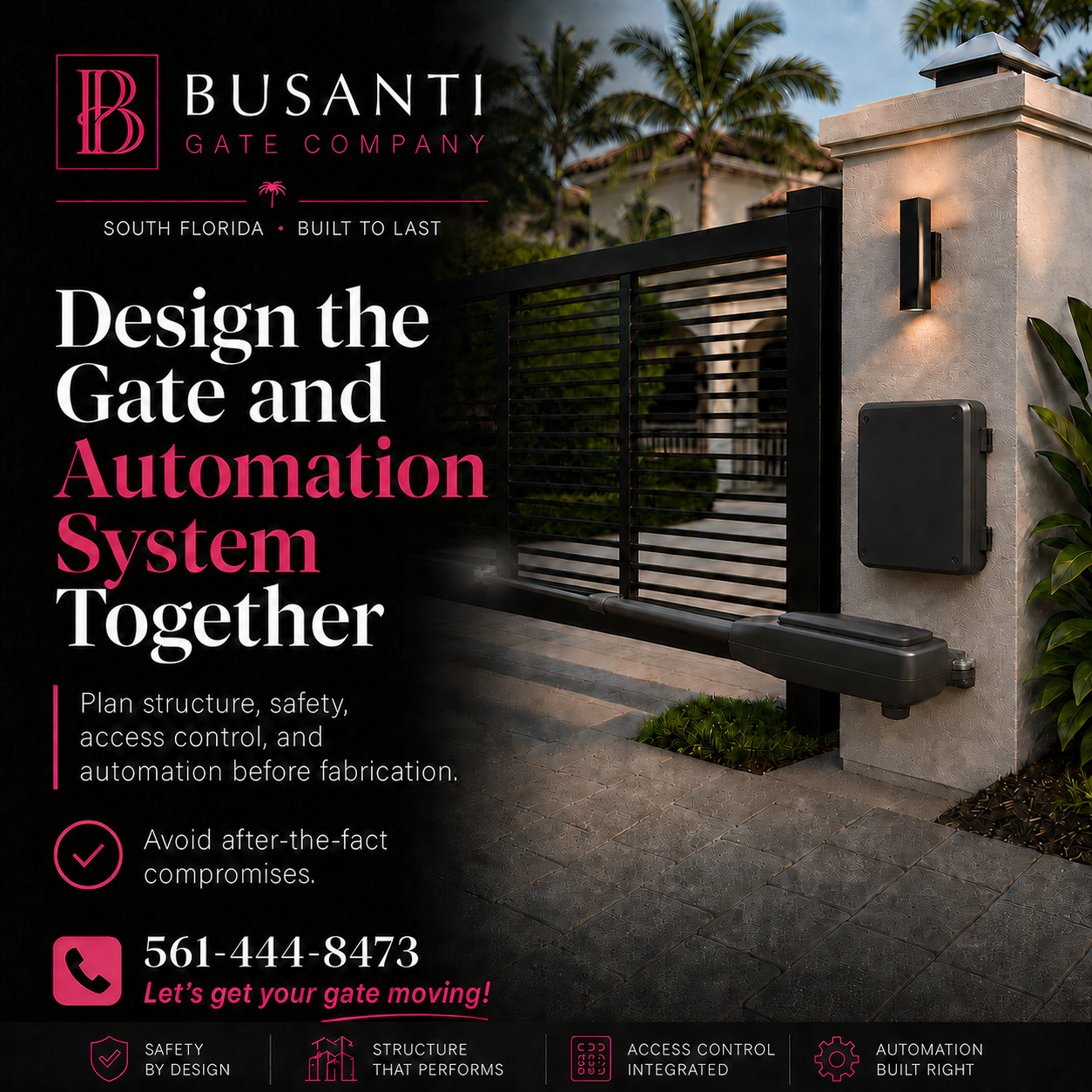
Before building a driveway gate in Florida, plan the gate, posts, wind load, safety devices, access control, and automation together. Busanti Gate Company explains why retrofitting later can cost more and look worse.
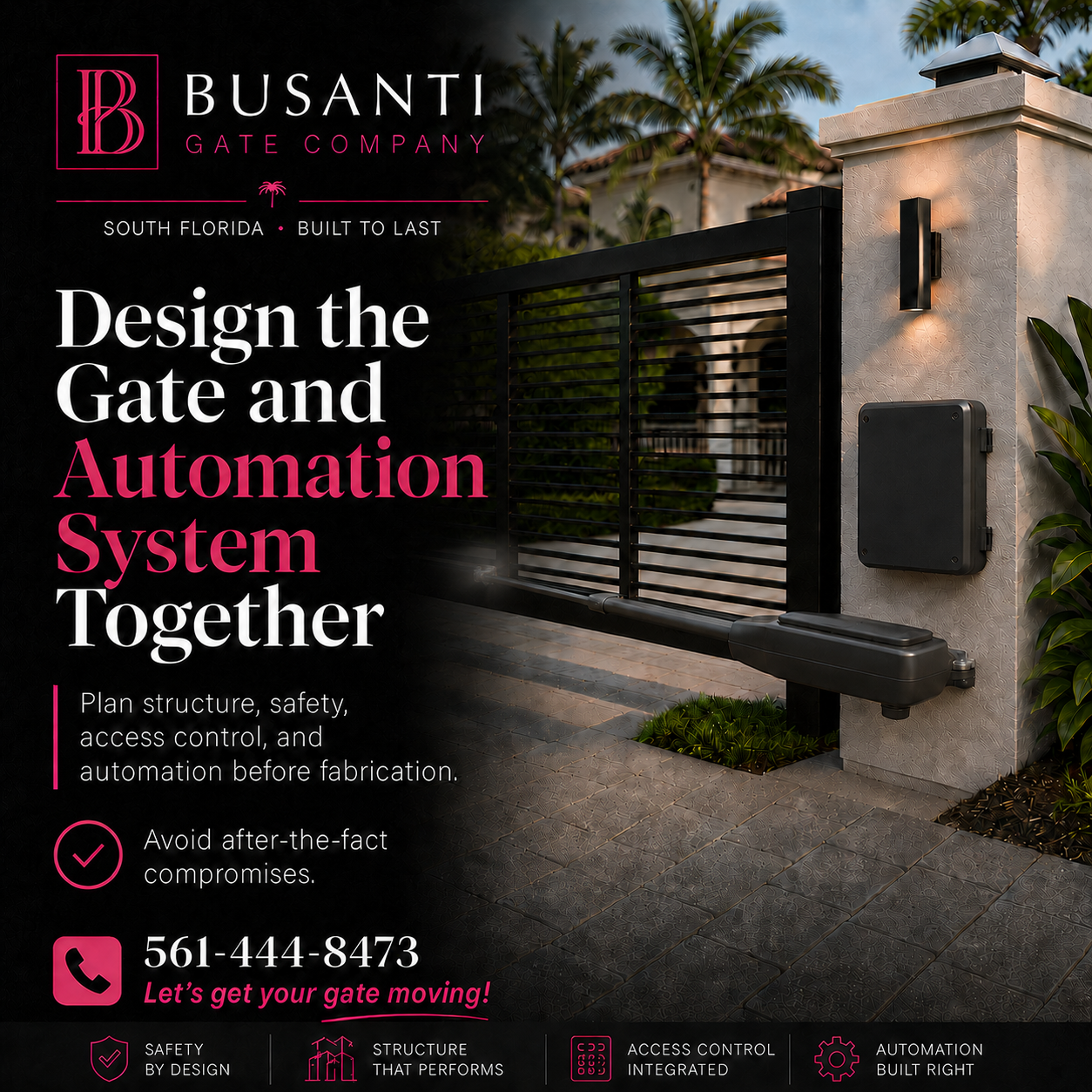
There is a major difference between a gate that happens to have an opener added later and a gate system that was designed from day one to be automated. The first approach often turns into field repairs, fabricated brackets, altered geometry, exposed wiring, awkward access-control placement, and an installation that looks patched together. The second approach produces a cleaner, stronger, safer, and more reliable entrance.
At Busanti Gate Company, we see this problem often. A property owner already has a gate installed, then later decides to automate it. Sometimes the gate looks good from the road, but the structure, post placement, hinge geometry, opening arc, access-control pathway, or safety layout was never planned for an operator. By the time automation is added, the installer may be forced to work around problems that should have been solved before fabrication.
The Best Gate Is Designed as a Complete System
A driveway gate is not just a decorative panel. Once it is automated, it becomes a moving mechanical system. The gate leaf, posts, hinges, brackets, operator, safety devices, access controls, conduit, power source, and controls all need to work together.
When those items are not planned together, the result can feel like a “hack job” even when good materials were used. Brackets may not land where they should. Operators may be mounted at odd angles. Wiring may be exposed or routed poorly. A gate may not open to its intended range because the available operator geometry cannot solve the site constraint. In some cases, the gate can be made to move, but not in a way that looks clean, feels professional, or performs properly long term.
Common Problems When Automation Is Added After the Fact
· Operator geometry does not match the gate: Swing gate openers have required mounting dimensions. If the hinge point, post size, setback, or gate frame was not designed with the opener in mind, the gate may not achieve the desired opening angle or may place unnecessary stress on the operator.
· Brackets do not fit cleanly: A gate frame may lack a proper mounting rail, crossbar, or reinforced point for the opener bracket. That can lead to field-fabricated brackets, visible plates, awkward welds, or mounting locations that look like an afterthought.
· Posts are not adequate for automation loads: A manual gate and an automated gate place different expectations on posts, footings, and hinge support. Ground movement, undersized posts, shallow footings, poor alignment, or weak hinge points can become more noticeable once a motor is pulling and pushing the gate every day.
· The gate is too heavy, too solid, or poorly balanced: Florida gates must be considered in the context of weight, wind exposure, frame design, bracing, and the duty rating of the selected operator. A decorative gate that was not planned structurally can create performance and safety issues when automated.
· Safety devices become difficult to place: Photo eyes, safety edges, monitored entrapment protection, warning signage, and protected areas need to be considered early. Adding them after the fact can create compromised layouts or exposed conduit.
· Access control was not pre-planned: Keypads, card readers, intercoms, cellular controls, exit devices, loops, cameras, and smart-home integrations need wire paths, power planning, and equipment locations. Without pre-conduit, the finished installation can become more invasive and less attractive.
Florida Adds Another Layer: Wind, Structure, and Code Awareness
In Florida, gate design should not ignore wind exposure. A wide gate with solid panels behaves very differently than an open picket-style gate. The more solid the gate, the more wind load it can transfer into the frame, hinges, posts, footings, and operator.
This is where engineering matters. Stamped engineering drawings, wind-load calculations, post sizing, structural bracing, and fabrication details can add thousands of dollars to a project, but they may be necessary depending on the gate design, jurisdiction, permit requirements, exposure, and project scope. The expensive mistake is building first and then discovering that the gate does not meet the structural or permitting expectation later.
Florida’s current building-code framework uses ASCE 7-22 for determining wind loads. Local jurisdictions can also have their own review practices, permit expectations, and documentation requirements. That is why gate design should be discussed before fabrication, not after the gate is already hanging on the posts.
Safety is important
Automated vehicular gates must be approached as moving systems with real entrapment and impact risk. UL 325 is the primary safety standard for gate operators, and ASTM F2200 is commonly referenced for automated vehicular gate construction. Together, these standards help frame how operators, gates, entrapment protection, and installation details should be considered.
A clean installation is not only about appearance. Correct safety planning can affect where photo eyes are placed, whether safety edges are needed, how the gate stops and reverses, how the operator monitors external devices, and whether the overall system is suitable for the property. Using listed equipment and maintaining required safety protections should not be compromised to make an after-the-fact installation easier.
Plan Before Concrete, Posts, and Pavers
The best time to plan access control is before the gate is built and before hardscape is finished. Keypads, intercoms, cameras, cellular modules, exit devices, vehicle sensors, smart-home controls, and Control4-style integrations all benefit from proper conduit and power planning.
When conduit is missing, installers may have to trench after landscaping is finished, surface-mount wiring, use less ideal wireless workarounds, or place equipment where it is convenient rather than where it should be. For high-end properties, that difference matters. The entrance should look intentional, not pieced together.
What to Consider Before Building a Gate
· Will the gate be manual only, automated now, or automated later?
· What opening angle is required, and is there room for the correct operator geometry?
· Are the posts, footings, hinges, and frame designed for the gate weight and wind exposure?
· Does the gate design allow proper bracket placement without awkward fabrication?
· Is there a reinforced crossbar or mounting location for the operator?
· Is the gate open enough for Florida wind conditions, or does it require engineered structural review?
· Are stamped drawings or permit documents likely to be required by the jurisdiction?
· Where will photo eyes, safety edges, warning signs, and protected zones be located?
· Where will keypad, intercom, camera, exit sensor, loop, cellular, or smart-home equipment go?
· Has conduit been installed before concrete, pavers, landscaping, or final grade work?
· Is the selected operator properly rated for the gate size, weight, duty cycle, and site conditions?
· Will the final installation look clean from the street and from inside the property?
The Bottom Line
A gate should not be designed in isolation and then handed off to automation later. That approach often creates unnecessary cost, compromises appearance, and limits performance. The strongest result comes from designing the gate, structure, operator, safety layout, access control, and wiring pathway as one complete system.
If you are planning a new driveway gate in South Florida, think beyond the panel. Think about the full entrance system before fabrication begins. Busanti Gate Company can help property owners evaluate gate design, automation compatibility, access-control planning, and practical installation details before the costly after-the-fact problems begin.
Solar-Powered Convenience: Why TOPENS Sliding Gate Openers Are a Smart Choice

Busanti Gate Company is an Authorized Topens Dealer.
For property owners seeking reliable access control without trenching, excessive wiring, or rising utility costs, solar-powered sliding gate openers have become the gold standard. Among the leaders in this space is TOPENS, a manufacturer known for pairing engineering discipline with practical, installer-friendly design.
This article breaks down why TOPENS solar sliding gate operators are an excellent solution for residential, equestrian, and light-commercial applications—particularly in sunny regions like South Florida.
What Makes a Solar Sliding Gate Opener Different?
A solar sliding gate opener uses photovoltaic panels to charge onboard batteries, powering the operator without a hard electrical connection. The result is:
No trenching or conduit runs
Faster installation timelines
Lower long-term operating costs
Continued operation during power outages
When properly designed, solar systems are not a compromise—they are an upgrade.
Why TOPENS Excels in Solar Applications
TOPENS designs its operators with solar use in mind, not as an afterthought. Several characteristics set them apart:
1. Efficient Power Management
TOPENS control boards are optimized for low current draw, allowing gates to cycle reliably even during periods of cloud cover. This efficiency extends battery life and reduces system stress.
2. Scalable Solar Configurations
TOPENS systems support:
Larger solar panels (beyond basic operator kits)
Dual battery configurations
External battery enclosures for thermal protection
This scalability is critical for:
Longer or heavier sliding gates
Higher daily cycle counts
Properties with partial shade
3. Strong Compatibility with Safety & Access Devices
A solar setup doesn’t mean sacrificing features. TOPENS sliding gate openers integrate seamlessly with:
Photo-eye safety sensors
Wireless keypads
Wi-Fi access modules
Remote transmitters
All without destabilizing the solar power system when properly configured.
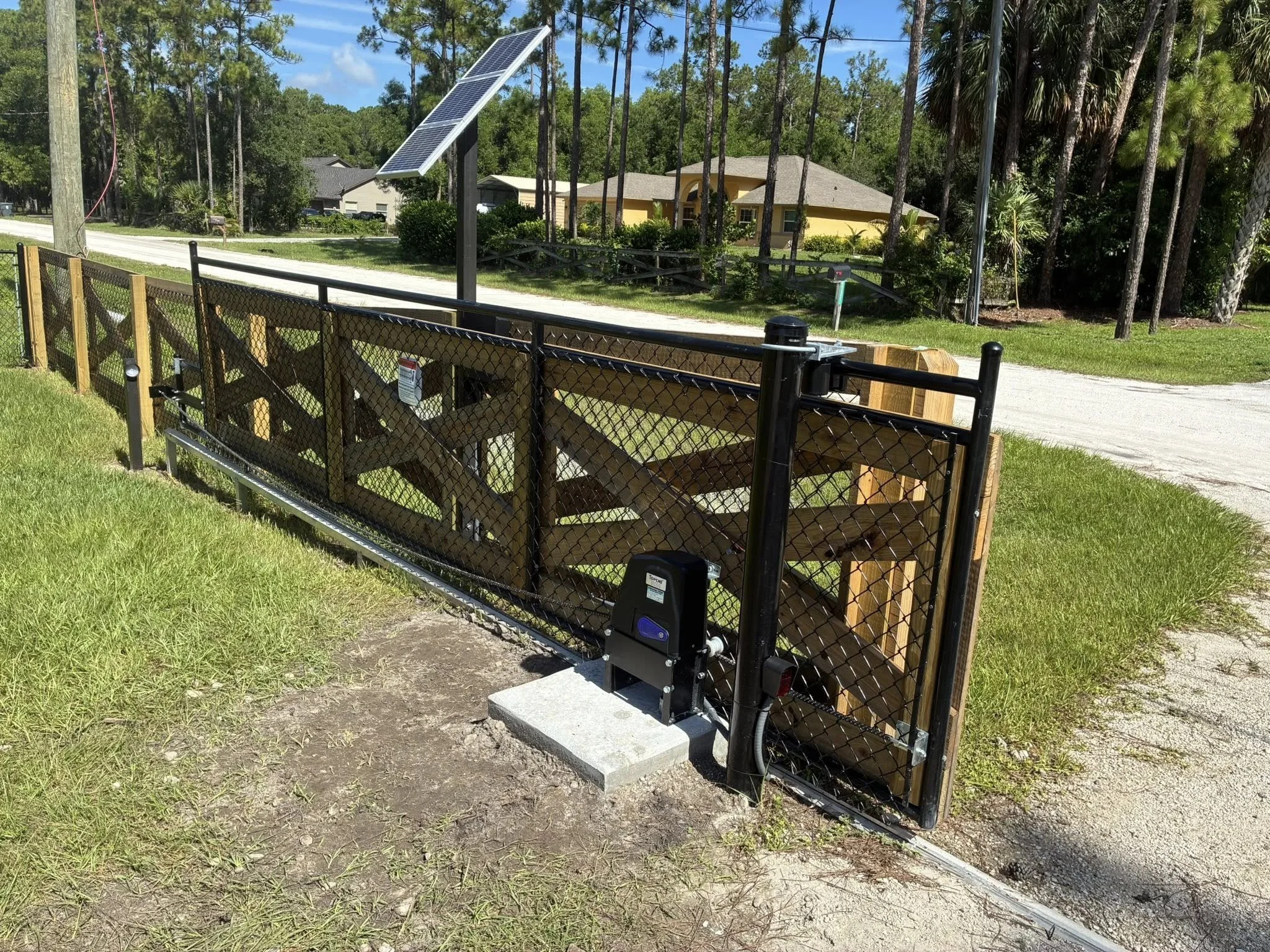
Busanti Gate Company LLC - Authorized Topens Dealer - Sliding Gate Opener DKC1000s
Ideal Use Cases for TOPENS Solar Sliding Gate Openers
Solar-powered TOPENS systems are especially well suited for:
Rural and equestrian properties where utility power is distant
Large residential estates prioritizing clean aesthetics
Gated driveways with long runs where trenching is cost-prohibitive
Backup-power-critical sites that must operate during outages
In many installations, solar is not only viable—it is the most logical option.
Installation Matters More Than the Brand
While TOPENS builds robust equipment, solar performance ultimately depends on correct system design. Key considerations include:
Gate weight and rolling resistance
Daily open/close cycles
Panel orientation and sun exposure
Battery capacity and enclosure placement
When these variables are addressed during design—not after installation—TOPENS solar systems deliver consistent, long-term performance.
Final Thoughts
Solar gate automation is no longer niche or experimental. With the right equipment and proper system design, it is dependable, elegant, and cost-effective.
TOPENS sliding gate openers, when paired with a correctly sized solar and battery setup, offer a refined balance of efficiency, durability, and modern access control—without reliance on the electrical grid.
For property owners seeking a future-proof gate automation solution, solar-powered TOPENS systems remain a compelling choice.
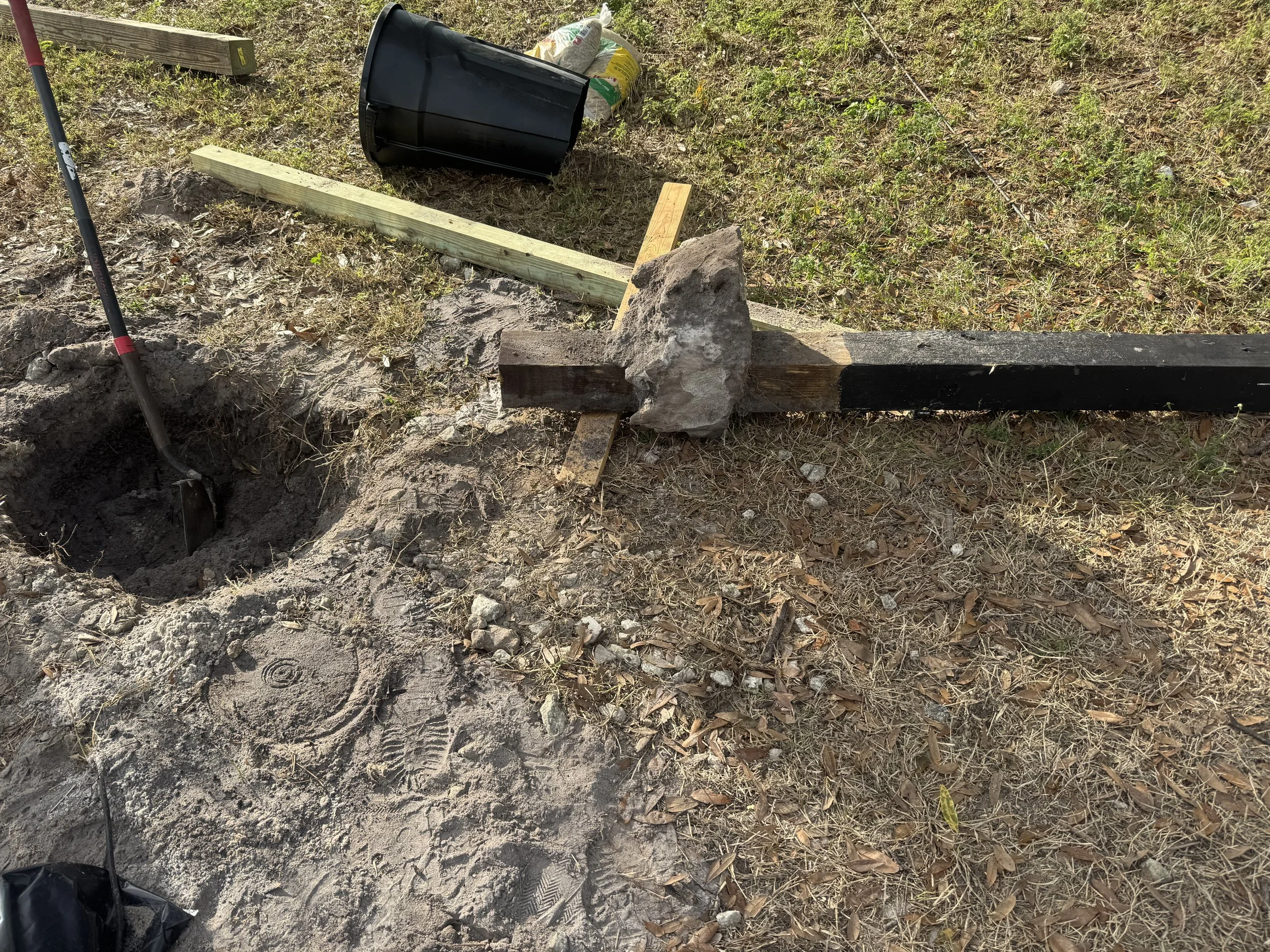
Why Properly Setting Posts in Concrete Matters for Gates.
A gate or fence is only as strong as the post supporting it. Properly setting posts in concrete is essential for preventing sagging, misalignment, and premature failure—especially for heavy or automated gates. This article explains why depth, diameter, and material choice matter, and how correct concrete footings protect your investment for years to come.
When it comes to gates and fences, the strength of the entire system depends on one critical element: the post. No matter how well-designed or beautifully fabricated a gate may be, improper post installation will eventually lead to sagging, misalignment, or failure. Setting posts correctly in concrete is not optional—it is foundational.
The Purpose of Concrete Footings
Concrete serves three essential functions for gate and fence posts:
Load distribution – Spreads the weight of the gate across stable soil
Lateral resistance – Prevents leaning, twisting, or shifting over time
Longevity – Protects against soil erosion, moisture movement, and wind loads
In South Florida and similar regions, sandy soils and seasonal rain make proper concrete footings even more critical.
Depth and Diameter: Getting the Footing Right
A general rule of thumb is that one-third of the post height should be below grade, but gates require more reinforcement than standard fencing.
For example:
A 6-foot gate post often requires 36–48 inches of embedment
Heavier or automated gates may require larger diameter footings or reinforced concrete
The diameter of the hole matters just as much as depth. A narrow hole filled with concrete does not provide the same resistance as a properly sized footing that grips the surrounding soil.
Post Material Considerations
Different post materials interact with concrete differently:
Pressure-treated wood must be isolated properly to avoid rot at the concrete interface
Steel or aluminum posts benefit from precise alignment and plumb setting before the concrete cures
Structural gate posts often require thicker-wall materials and deeper footings than fence posts
Each material requires a deliberate approach—there is no universal shortcut.
Why Gates Demand More Than Fences
Gates introduce dynamic forces that fences do not:
Opening and closing cycles
Wind load on large panels
Added stress from automation systems
An automated gate can exert hundreds of pounds of force on its hinge post. Without a properly engineered concrete footing, even a well-built gate will fail prematurely.
Common Mistakes to Avoid
Shallow holes that rely on surface concrete
Dry-pouring concrete without proper compaction
Failing to brace posts during curing
Undersizing footings for automated or wide gates
These issues often do not show immediately—but they will surface months or years later.
The Long-Term Value of Doing It Right
A correctly set post:
Keeps gates aligned
Reduces maintenance and service calls
Extends the life of automation equipment
Preserves property value and curb appeal
Cutting corners at the post stage almost always leads to higher costs later.
Final Thought
Posts are not just supports—they are structural anchors. When they are set correctly in concrete, everything built on top of them performs better, lasts longer, and operates as intended.
If you’re planning a new gate or evaluating an existing one, the footing below ground matters just as much as what you see above it
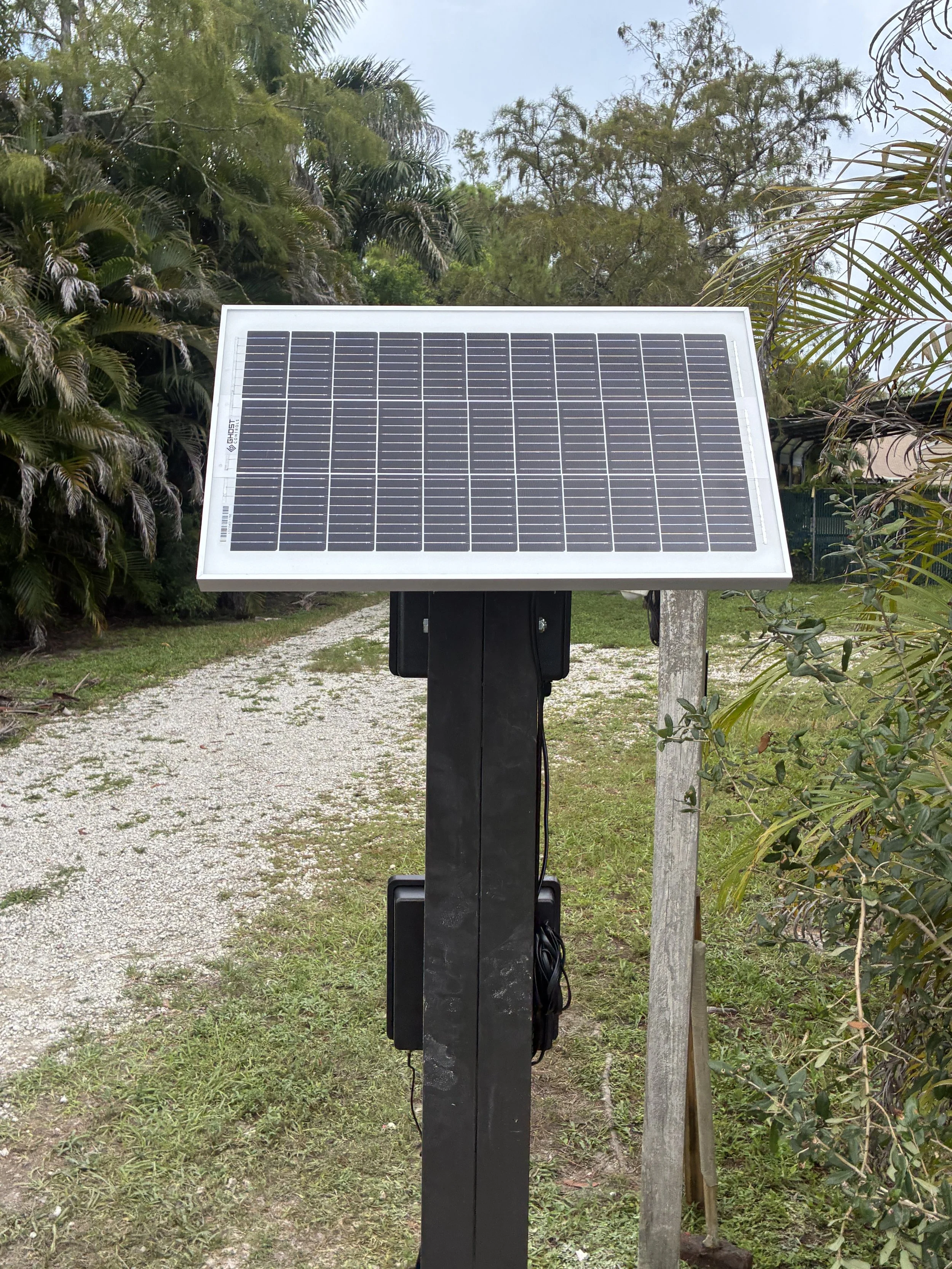
Powering Your Gate: AC vs Solar — Which Is Right for You?
Choosing between a solar or AC-powered gate opener? This guide breaks down cost, reliability, maintenance, and performance so you can make the right decision for your property. Unsure which system fits your layout or power access? Schedule a professional gate automation site review today.
⚡ AC Power: Consistent and Strong
AC-powered gate operators connect directly to your home’s electrical system, giving you steady and reliable power.
Pros:
Handles heavy gates and frequent cycles with ease
Works consistently in all weather conditions
No need to worry about cloudy days or battery storage
Best for:
Homes with easy access to power near the gate and high daily use, such as driveways with multiple cars or frequent visitors.
Things to consider:
AC-powered systems need underground wiring, a dedicated circuit, and sometimes trenching, which can add to installation cost — but offers unmatched reliability.
☀️ Solar Power: Sustainable and Smart
Solar-powered gates use energy from the sun stored in a battery backup system, making them eco-friendly and cost-effective over time.
Pros:
No electric bill impact — uses free solar energy
Keeps working during power outages
Easier setup for remote properties where AC power isn’t nearby
Best for:
Gates used fewer than 10–15 times a day, or rural/equine properties where running electrical lines is expensive or difficult.
Things to consider:
Cloudy days and heavy gate use can drain the battery
Panels should be angled correctly and kept clean for best performance
May need battery replacement every few years
🔋 Solar Panel Size: Why We Recommend 30 W
Not all solar panels are created equal — and the size of your panel directly affects how reliably your gate runs.
Many gate kits include a 10-watt panel, which can power a gate lightly used just a few times a day. But here in Palm Beach County’s heat and humidity, real-world factors like cloud cover, dust, and battery loss can quickly drain that small panel’s capacity.
At Busanti Gate Company, we install and recommend 30-watt solar panels for most systems.
Here’s why:
✅ Faster charging — keeps batteries topped off even after several openings per day
✅ More reserve power — prevents sluggish performance or mid-cycle stalls
✅ Longer battery life — less strain on your backup system
✅ Handles accessories — motion sensors, keypads, or Wi-Fi controllers draw extra power
While 10-watt systems might work in perfect sunlight, 30-watt panels provide the reliability homeowners expect — especially when paired with a deep-cycle battery and quality controller. It’s a small upgrade that pays for itself in peace of mind.
⚙️ Busanti Gate Company’s Recommendation
In Palm Beach County’s sunny climate, both options work beautifully.
We often recommend solar systems for remote areas — clean energy and reliability in one.
For high-traffic entrances, AC power with a battery backup ensures your gate runs no matter what.
🛠️ Let’s Build the Right Solution for You
At Busanti Gate Company, we design and build gate systems that fit your property, your lifestyle, and your power setup — whether it’s AC, solar, or hybrid.
📞 561-444-8473
📧 helllo@busantigatecompany.com
🌐 busantigatecompany.com
📅 Schedule your consultation today: Book Now

How Much Concrete Do You Need for Your Gate Posts?
A strong gate starts with strong footings. Learn how much concrete you really need to keep your driveway gate posts upright and secure—even in Florida’s sandy soil and high winds.
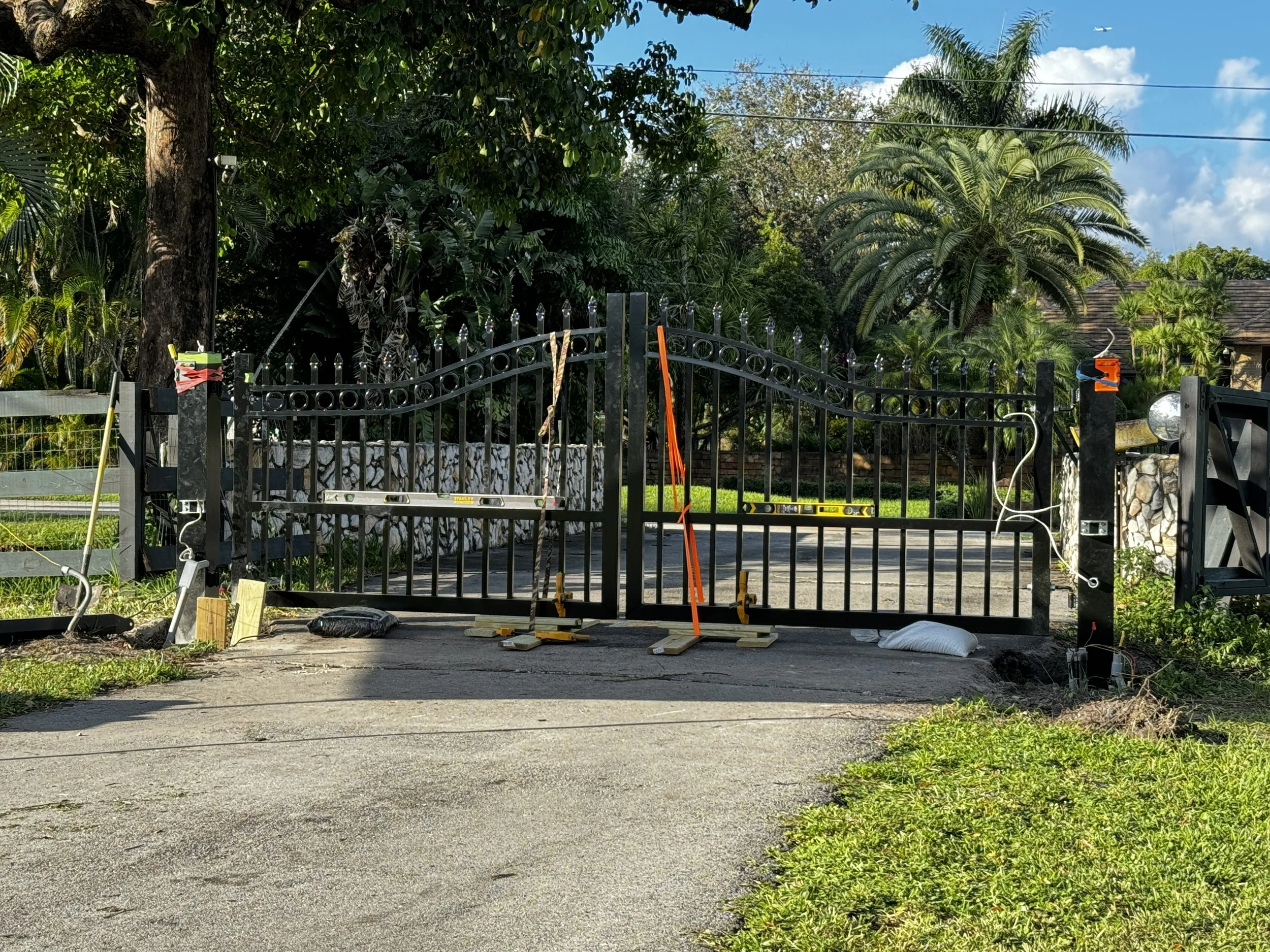
Learn the right amount of concrete to keep your driveway gate upright and secure. From small aluminum gates to heavy privacy gates, Busanti Gate Company explains footing sizes, bag counts, and tips for lasting strength in Florida’s sandy soil.
When you’re installing a driveway gate, the concrete footing is what keeps everything standing straight. If the posts aren’t set in the right amount of concrete, the gate will lean, sag, or even fail after a strong storm.
Why Concrete Matters
Your gate posts act like levers. When the wind pushes on the gate, or when the opener pulls it open, all that force transfers down into the ground. A deep, solid concrete footing spreads that load and keeps the post from shifting.
General Rule of Thumb
Gate size up to 10–12 feet wide, picket style (lots of air flow):
12″ round hole × 36–42″ deep → about 4–5 bags of 80-lb concrete per post.Heavier or semi-solid panels (wood, composite, slats):
14″ round hole × 42–48″ deep → about 6–7 bags of 80-lb concrete per post.Solid privacy gates (solid aluminum, wood, etc.):
16″ round hole × 48″ deep → about 9–10 bags of 80-lb concrete per post.
(South Florida soils are sandy—err on the larger side to stay secure during high winds.)
Quick Tips
Dig holes straight-sided, not wider at the top. A “bell” shape at the bottom helps lock it in.
Always brace posts plumb (perfectly vertical) before you pour.
Crown the top of the concrete so water runs away.
Don’t hang the gate or run the opener until the concrete cures (at least 2–3 days).
Bottom Line
A strong gate starts with strong footings. If you skimp on concrete, the gate will remind you every time it leans or drags. Invest in the right size footing up front, and your gate will stay upright for years.

Guarding Your Gate's Rolling Wheels: Safety First, Compliance Always
Protect Your Property. Guard the Wheels.
Don’t let a simple oversight lead to a serious accident or liability claim. Make sure your sliding gate’s wheels are guarded, secure, and code-compliant.
Your peace of mind—and your family’s safety—are worth it.
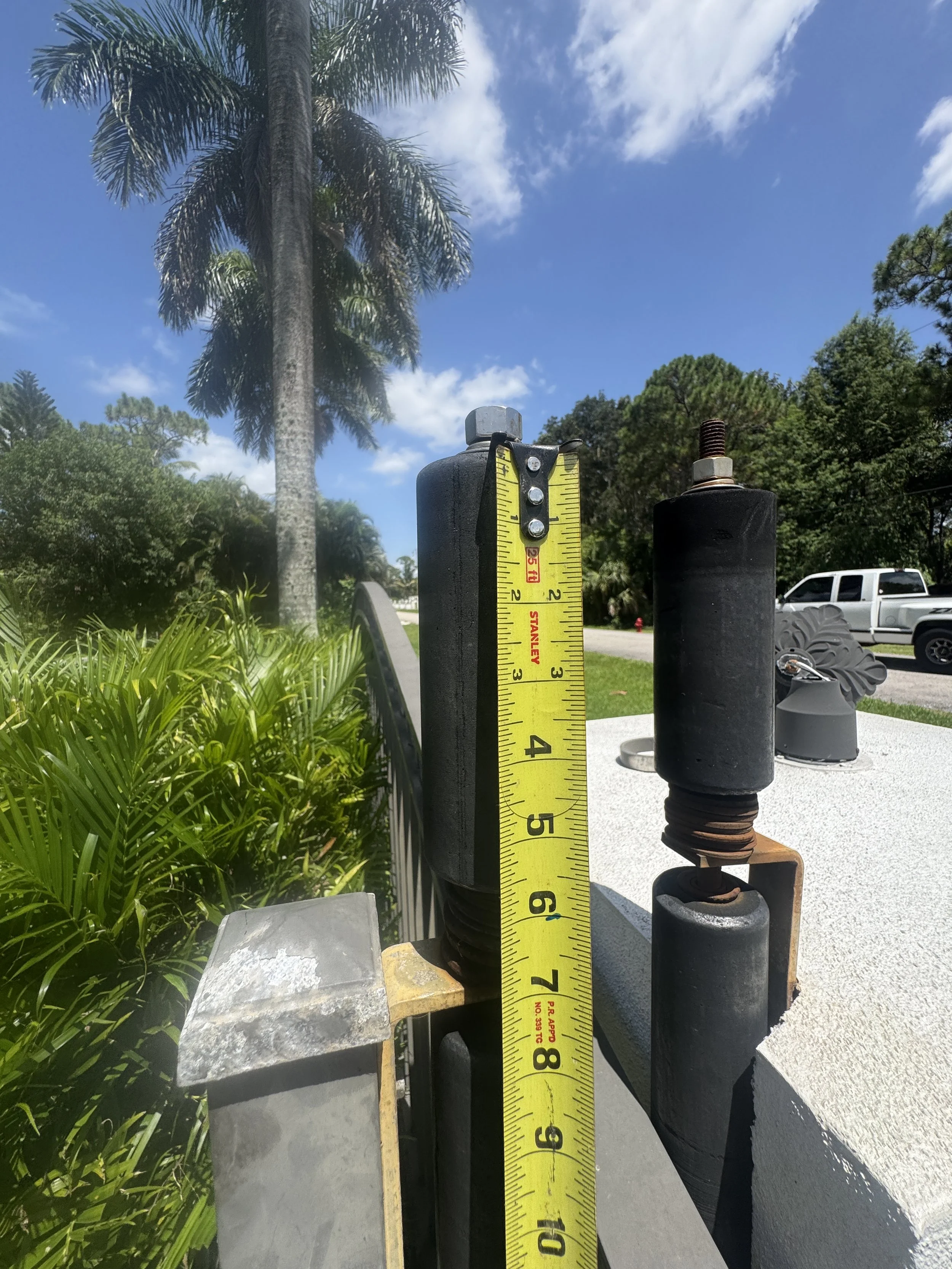
Guarding the Rolling Wheels on Your Gate: A Must for Safety and Code Compliance
When it comes to automated sliding gates, convenience and security are only part of the equation. One of the most overlooked—yet essential—components of gate safety is ensuring that the rolling wheels are properly guarded.
If you own or install sliding gates, especially in residential, ranch, or equestrian settings like those we serve throughout Loxahatchee, Wellington, and the western communities of Palm Beach County, this small detail can have serious consequences if ignored.
Why Are Wheel Guards So Important?
Rolling gate wheels often travel along ground tracks or behind the frame of the gate. These wheels can pose a hazard to children, pets, and even adults if they are exposed—leading to the risk of entrapment, crushing, or limb injury.
Proper wheel guards:
Prevent hands, feet, and objects from becoming trapped between the gate and the supporting surface
Improve the gate’s long-term structural performance by shielding components from debris
Demonstrate that your gate system was installed with safety and code compliance in mind
What the Standards Say: ASTM F2200 and UL 325
Busanti Gate Company installs and services gate systems in accordance with two primary safety standards:
ASTM F2200 – The Standard Specification for Automated Vehicular Gate Construction, which mandates that sliding gates must be guarded in all pinch points and openings that could pose an entrapment hazard.
Specifically, Section 6.1.1 of ASTM F2200 requires that rollers exposed in the gate's plane of travel be guarded or shielded to prevent contact.
UL 325 – The Standard for Safety for Door, Drapery, Gate, Louver, and Window Operators and Systems, which requires automated gate systems to be installed in a way that minimizes the risk of entrapment or injury. Though UL 325 primarily covers the operator itself, it defers to ASTM F2200 for construction elements—including wheel guards.
Together, these standards work to reduce the risk of injury and liability, which is why all reputable installers—including Busanti Gate Company—adhere to both.
How We Help
At Busanti Gate Company, we take safety seriously. Our team:
✅ Installs fully enclosed wheel guards on all new sliding gates
✅ Performs inspections and retrofits on existing gates to meet code
✅ Educates homeowners and property managers about ongoing safety obligations
We also design and build custom solutions, so even if your gate is unique, we can create compliant and durable safety shielding that blends seamlessly with your gate’s aesthetic.
Schedule a Gate Safety Tune-Up
Not sure if your gate is compliant? We offer gate safety inspections and tele- service calls across Loxahatchee, Wellington, Jupiter Farms, and beyond.
🔗 Book a gate tele service visit now
📞 Call us at 561-444-8473

🚫 Why Wrought Iron Gates Don’t Work in South Florida 🚫
Thinking about installing a wrought iron gate? Think again. Here in South Florida, the climate is not your friend when it comes to iron.
Thinking about installing a wrought iron gate? Think again. Here in South Florida, the climate is not your friend when it comes to iron.
🌴 High Humidity + Salt Air = Corrosion Nightmare
Within a short time, that elegant gate becomes a rusted, flaking liability — especially near the coast. Even powder-coated wrought iron can't withstand our relentless elements.
🔥 Warping & Paint Failure
Daily sun exposure, heavy rain, and shifting soil conditions cause traditional wrought iron gates to warp, peel, and sag — turning beauty into burden.
💡 Better Solutions Exist
At Busanti Gate Company, we build custom gates engineered for South Florida — using aluminum, stainless hardware, and finishes designed to endure. Lightweight, rustproof, and made to last.
➡️ Ask us about our hurricane-ready, low-maintenance gate options!
📍Proudly serving Loxahatchee, Wellington, Jupiter Farms, and beyond.
📞 561-444-8473
📅 Book your free consultation: www.BusantiGateCompany.com/schedule

The Truth About Farm Gates: Yes, They Sag — But There’s a Right Way to Fix It
Farm gates sag — it’s not a flaw, it’s a fact. Quick fixes like wheels and chains are just temporary. At Busanti Gate Company, serving Loxahatchee, Florida, we build and install gates the right way with proper hinges, materials, and expert craftsmanship — so your gate stands strong for years to come.
If you own a farm, ranch, or rural property in South Florida, chances are you’ve seen it happen — your gate that once stood straight and level starts sagging. It’s not your imagination — it’s a fact. Almost all farm-style gates, especially those long, lightweight tube gates, will eventually sag.
At Busanti Gate Company, we’ve seen it all, and we believe in being upfront: sag happens. But how you handle it makes all the difference.
Why Do Farm Gates Sag?
It comes down to basic physics and materials:
✔ Long, unsupported spans naturally flex over time
✔ Lightweight metal gates aren't built for structural rigidity
✔ Improperly set or weak gate posts accelerate the problem
✔ Inexpensive hinges or poor installation create stress points
Even with perfect installation, over time, the weight of the gate and environmental factors (heat, rain, wind) will cause sagging.
The Common Band-Aid Fixes
We often get called to fix sagging farm gates that have had these "quick fixes" applied:
⚠️ Wheels or Caster Supports — These help in the short term but wear down quickly, especially in sandy, uneven terrain.
⚠️ Third Hinge Installation — Provides temporary reinforcement but doesn’t address the underlying problem.
⚠️ Suspension Cords or Chains — An old-school trick to hold the gate level, but it looks unsightly and rarely holds up long-term.
These are all just Band-Aids, not permanent solutions.
The Real Solution: Quality Materials & Expert Installation
At Busanti Gate Company, we take a different approach:
✔ We properly set heavy-duty gate posts in concrete
✔ We use high-quality, appropriately rated hinges
✔ We design and fabricate gates with sag-resistance in mind
✔ We never cut corners on hardware or structural integrity
✔ We ensure alignment, level, and swing are correct from day one
A gate properly designed, built, and installed by experienced professionals will last years longer and stay level — no wheels, chains, or improvised fixes required.
Stop Fighting with a Sagging Gate
Tired of propping your gate up, replacing wheels, or dealing with constant adjustments? It's time to invest in a properly built gate that functions — and lasts.
Schedule a gate evaluation today:
www.busantigatecompany.com/schedule
Or call 561-444-8473 for expert advice and honest solutions.
Busanti Gate Company — Design • Build • Self install to Automate • Tele Service
Proudly serving Loxahatchee, Wellington, Jupiter Farms, and beyond.

Is Your Gate Safe? The Truth About Safety Devices and Gate Automation.
Is you gate safe for family, visitors, and deliveries? Learn how often your gate system should be serviced based on usage and how regular maintenance prevents breakdowns and battery failure. Keep your property secure with expert gate care from Busanti Gate Company.
Gate automation offers incredible convenience, security, and peace of mind. But just like a garage door or automatic sliding door, your gate should be equipped with proper safety devices to protect your family, visitors, and property.
At Busanti Gate Company, we believe your gate should not only function — it should operate safely.
What Are Gate Safety Devices?
Safety devices are designed to prevent accidents, property damage, or injury caused by an automated gate. These devices may include:
✅ Photoelectric Sensors (Photo Eyes) — These detect movement across the gate’s path and stop the gate if something or someone crosses it.
✅ Edge Sensors — Pressure-sensitive strips that stop the gate if they make contact with an object.
✅ Audible Alarms & Lights — Warn nearby pedestrians or vehicles when the gate is in motion.
✅ Automatic Reversing Features — Ensures the gate reverses direction if an obstruction is detected.
These are standard features we recommend on most automated gate systems to comply with UL 325 and ASTM F2200safety standards.
But What About Solar Gate Systems Like Ghost Controls?
Solar-powered gate openers, like Ghost Controls, are popular across South Florida, especially in rural areas like Loxahatchee, Wellington, and Jupiter Farms, where electrical connections may be difficult to access.
While these systems offer affordable and convenient automation, it's important to understand their limitations:
⚠️ Ghost Controls Solar Gate Openers are not designed to support additional safety devices such as photo eyes or edge sensors.
⚠️ This means, aside from the built-in obstruction sensing, there are no external safeguards to enhance safety beyond the standard factory settings.
⚠️ For properties with children, pets, or high foot traffic, this limitation is important to consider.
Our Recommendation
We love solar gate solutions for the right property — but safety should always come first. We recommend:
✔ Discussing your property's needs with a gate professional
✔ Choosing a system that supports safety devices if your property sees regular pedestrian or vehicle traffic
✔ Considering electrical upgrades if safety features are a priority
✔ Understanding that in some rural setups, Ghost Controls Solar systems are best suited for low-traffic, vehicle-only access points
Your Gate, Your Choice — But Always Safe
When you work with Busanti Gate Company, we explain your options, the safety features available, and the limitations of different gate systems — so you can make an informed, confident decision.
Whether it's a simple solar gate or a fully automated, UL-rated system with advanced safety, we design, build, automate, and provide tele-service for your gates with your safety in mind.
Need a Gate Evaluation?
Schedule a free safety consultation today:
www.busantigatecompany.com/schedule
Or call 561-444-8473 for expert advice.
Busanti Gate Company — Design • Build • Automate • Service (tele-service)
Proudly serving Loxahatchee, Wellington, Jupiter Farms, and surrounding communities.

Is Your Gate Safe for Visitors? Why Regular Service is Essential
Is you gate safe for family, visitors, and deliveries? Learn how often your gate system should be serviced based on usage and how regular maintenance prevents breakdowns and battery failure. Keep your property secure with expert gate care from Busanti Gate Company.
Your gate is the first thing visitors, family, and even delivery drivers encounter at your property. But is it safe? Is it reliable? At Busanti Gate Company, we often find that homeowners and businesses don’t realize how important regular gate service is—until a failure happens.
Whether your gate protects your home, business, or farm, ensuring it's properly maintained isn’t just about convenience—it’s about safety.
How Often Should You Service Your Gate?
The truth is, every gate is different. Factors like traffic volume, usage patterns, and even Florida's harsh weather impact how often your system should be inspected and maintained. Here's our general recommendation:
✅ Monthly Service:
For high-traffic properties like businesses, equestrian facilities, or multi-family homes where the gate operates dozens—or hundreds—of times per day.
✅ Quarterly Service:
If your gate opens more than 25 times a day, we strongly recommend quarterly service. This is typical for busy households, farms, or properties with regular deliveries or visitors.
✅ Semi-Annual Service (Every 6 Months):
For most standard residential gates, especially those with moderate daily use, a twice-yearly service ensures components stay lubricated, aligned, and operating safely.
Don’t Let Dead Batteries Leave You Locked Out
Battery-powered gate openers are common in South Florida, especially for properties without convenient electrical connections. But batteries don't last forever.
Busanti Gate Company offers battery checks and replacements as part of our service visits, helping you avoid the frustration—and safety risk—of a non-functional gate when you need it most.
Peace of Mind, Year-Round
A malfunctioning gate isn’t just inconvenient—it can be dangerous. Broken safety sensors, misaligned hardware, or a gate stuck halfway open exposes your property and creates liability.
Our Gate Service Plans ensure your system is:
· ✔ Properly lubricated
· ✔ Aligned and tested
· ✔ Safety devices are working
· ✔ Batteries are checked and replaced as needed
Ready to Book a Busanti Care?
Click below to schedule your gate service and keep your property safe and secure:
https://www.busantigatecompany.com/schedule
Or call us at 561-444-8473 for expert advice.
Busanti Gate Company — Design • Build • Self- Automate • Tele-Service
Proudly serving Loxahatchee, Wellington, Jupiter Farms, and beyond.